Same AI tools, uneven results: how to align your teams
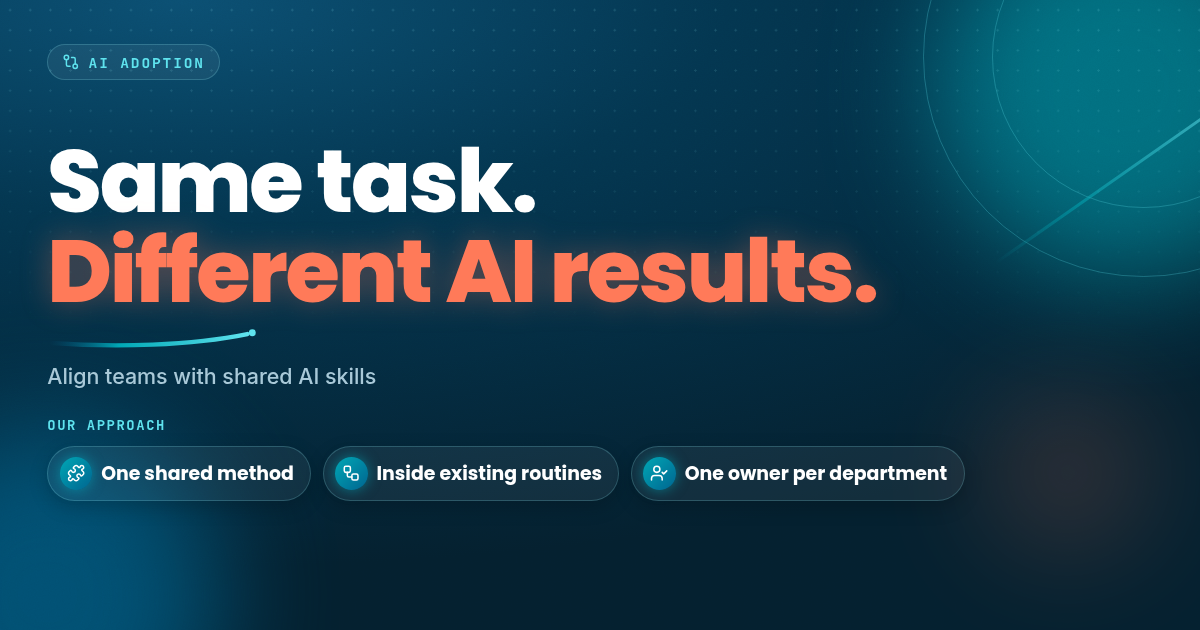
Your teams use ChatGPT or Claude, yet the same task gives different results depending on who does it. Our approach: shared AI skills for each department, tied to existing routines, each with one owner.
In most organizations, access to AI is no longer the question. Teams have ChatGPT, Claude, sometimes both. Yet as soon as you look at the work itself, the same pattern shows up: one task does not produce the same result from one person to the next.
Same task, very different results
Take an everyday task: writing up meeting notes, preparing a project brief, reviewing a specification. Give it to three colleagues who use AI. The first hands back something ready to send. The second hands back a decent draft that still needs work. The third spends more time fixing the tool's answer than it would have taken to write the thing from scratch.
None of them did a bad job. Each one has built a personal way of asking, checking and editing. Those habits stay personal. Nobody writes them down, compares them or passes them on.
We saw this in our own teams, and it is what made us act. The result depends less on which tool people use than on how they use it.
Why the gap holds back adoption
For a leader or a manager, this gap has a real cost, even if it never shows up on a dashboard.
- Quality becomes unpredictable. You cannot tell in advance whether a deliverable prepared with AI can go out as is or will need rework.
- Reviews pile up. Managers end up checking everything, which cancels out much of the expected gain.
- Know-how stays with individuals. When the most fluent person moves to another role, their method leaves with them.
- Trust wears thin. After a few bad surprises, teams fall back on old habits and AI stays on the margins.
The usual fixes do not address the root cause. Extra training makes people more skilled with a tool, but it does not bring their ways of working together. Standardizing on one tool does not help either: the gaps persist on a single tool, and the market moves too fast to build an organization around one product.
Our approach: shared AI skills for each department
What we are putting in place, and what we offer the organizations we work with, rests on a simple idea: make the way a task is done with AI explicit and shared.
We call this a shared AI skill. It is a written approach for one specific task: what you give the tool, what you ask it, and how you check what comes back. It works with ChatGPT as well as with Claude. Whoever does the task, it follows the same path.
Three principles shape the work.
Skills that belong to each department. Sales, technical and finance teams do not share the same tasks, so each department builds its own.
One owner per department. A shared skill with no owner always ends up splitting into personal versions. The owner keeps it current, gathers feedback from the people using it, and decides when it needs to change.
Every skill tied to an existing routine. It adds no process and no meeting. The skill sits inside a step the team already goes through. That is what keeps it from being forgotten after a few weeks.
An example: requirements approval
Our first skill covers requirements approval, a step that already exists in our software development life cycle (SDLC).
At this stage, the team has to make sure a requirement is clear, complete and testable before development starts. It is a step where differences between people show quickly. One person spots the ambiguities, another lets them through, and the problem resurfaces later, when it costs more to fix.
The skill describes how to submit a requirement to AI, which questions to ask, what to check in the answer, and what remains the team's responsibility. It lives inside the approval step itself. No one needs a reminder to "use AI." It is simply there, at a moment where the work is already happening.
This work has just started. We are running it in our own teams first, and we will share what we learn.
Where to start: one routine, one person, one skill
There is no need for a large transformation program. The starting point comes down to three choices.
- One routine. Pick a recurring task that several people already do, inside a step that already exists.
- One person. Name the person who will own the skill in the department. They look at how everyone works today, keep what works, and write down the shared approach.
- One skill. Write a single, simple approach that works with the tools already in place. Put it inside the chosen routine, then adjust it as feedback comes in.
Once that first skill is in place, the next one is easier to build: the format exists and the owner role is understood.
Let's scope your first step together
Are your teams using AI without getting comparable results? We can help you choose the right routine, name the right owner and write your first shared skill.