Copying AI access is not copying the win
Access to AI tools can be copied to a new department in a day. Habits cannot. We start from one weekly pain, put one name next to it, then talk about tools, with a distinct owner in each department.
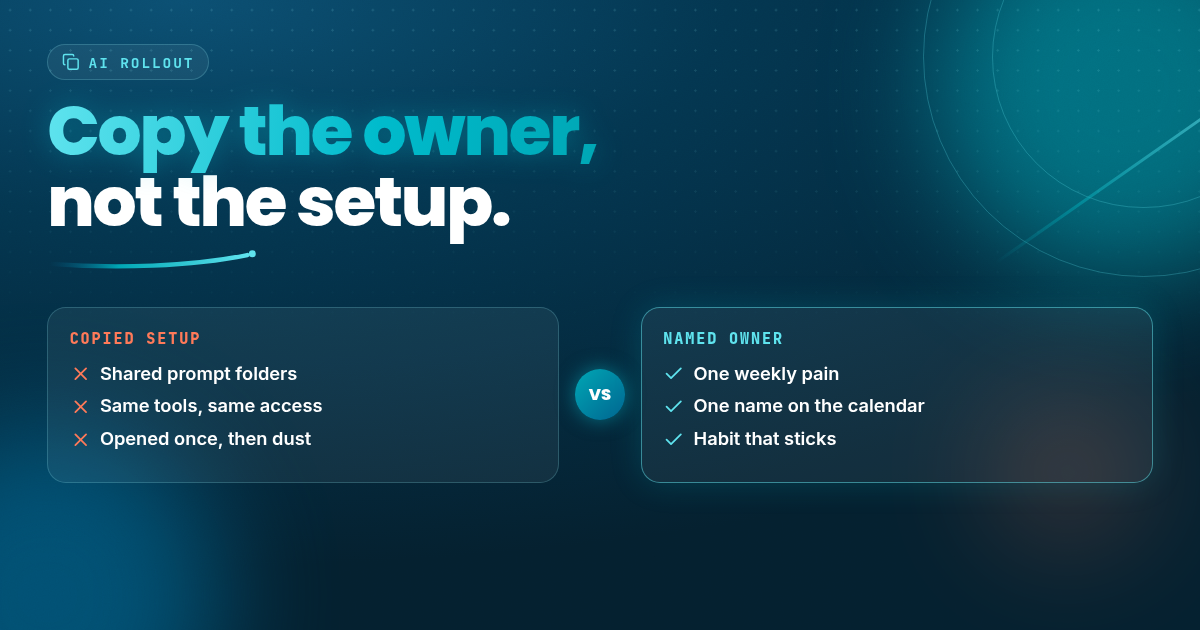
When a first department starts using AI well, the next request arrives fast: roll the same setup out to the rest of the organization. Same tools, same prompt library, same shared folder. Access can be ready in a day. Habits cannot.
We see this pattern in many organizations in Tunisia and across the francophone world. The first team has something that works. Leadership wants to scale it. The instinct is to clone. That instinct copies the wrong thing.
Access spreads. Habits do not.
Giving another department a login and a folder of prompts looks like progress. People can open the tools. They can try a prompt. A few even use them once. Then the weekly work takes over again, and the folder sits untouched.
A shared prompt library with no owner gets opened once. After that, each person invents their own shortcut, or goes back to the old way. The setup was copied. The habit was not.
What made the first team stick
In the department where AI actually stuck, something else was true. One person owned one weekly step. They kept the shared skill written and current. Colleagues knew who to ask. The tools mattered less than that ownership.
When you copy only the tools and the prompts into a second department, you leave that ownership behind. The second team inherits access without inheriting the habit that made the first team succeed.
Start from one weekly pain
We suggest a different order before any rollout to a new department.
- One weekly pain. A recurring friction the department already feels: a report that takes too long, a review that loops, a handoff that keeps coming back.
- One name next to it. Someone inside that department who will own the step, keep the shared skill alive, and answer questions.
- Then the tools. Only after the pain and the owner are clear do we talk about which AI access or prompts to give them.
This order flips the usual sequence. Most rollouts start with tools and hope the habit appears. We start with the habit's two ingredients: a pain that already exists, and a person who will carry it.
Each department needs its own owner
The owner of the first department cannot be the owner of the second. Their routines are different. Their calendar is different. Their colleagues listen to someone who knows their work, not someone who knows another team's tools.
Each department gets its own owner, not a copy of engineering's, finance's, or operations'. The shared skill is rewritten for that department's weekly step. The prompt library, if there is one, grows from that step, not from a dump of someone else's files.
A quick test before the next login
Before handing out another AI login to a new department, we suggest three questions:
- Which weekly pain will this access reduce?
- Whose name sits next to that pain?
- Will that person keep a shared, written way of working for the team?
If any answer is missing, the rollout will most likely copy access and leave the habit behind.
What we are building on
Last week we wrote about starting from one routine rather than a big training pathway. The same logic applies when AI moves from one department to the next. Do not clone the setup. Rebuild the ownership.
We apply this in our own work as we grow department by department, and we will keep sharing what we learn.
Before the next login
What's the one weekly pain you'd hand to a named owner before you hand out another AI login? If you want help naming that first pain and its owner in a second department, let's talk.