Skip the AI pathway: start with one routine your team already runs
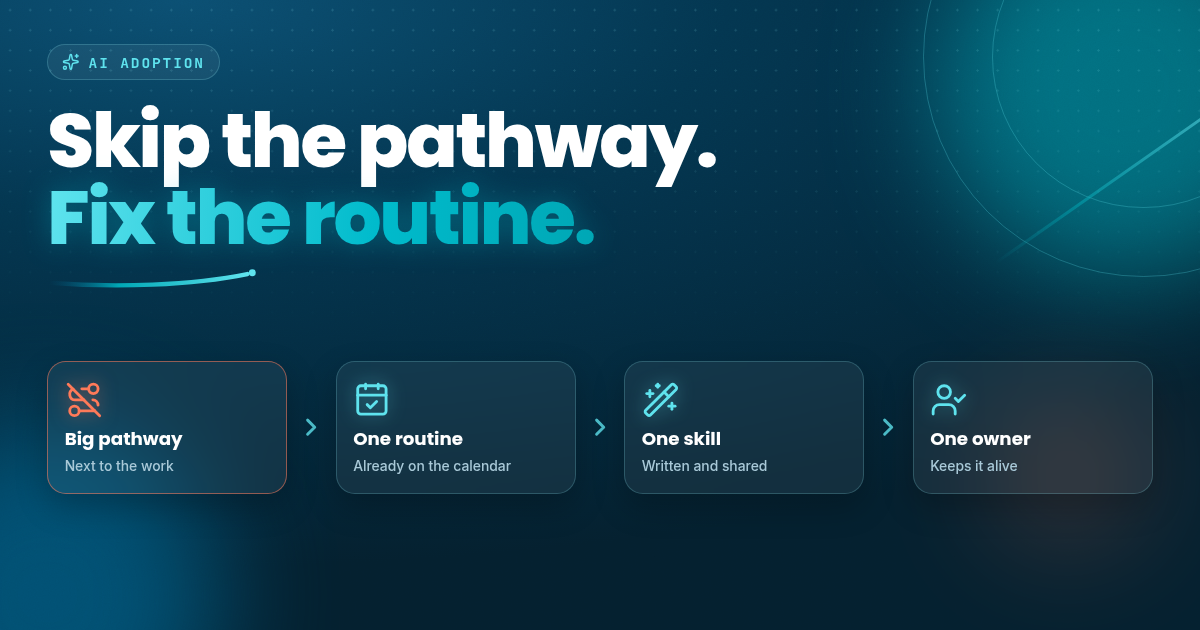
Big AI training pathways sit next to the work, and busy teams pick the work. We start from one routine a department already runs, one shared skill and one owner, then grow one department at a time.
In many organizations, in Tunisia and beyond, the decision to get serious about AI triggers the same first move: buying a full training pathway. Modules, badges, a certificate at the end. It looks like progress. A few months later, many leaders notice something uncomfortable: people completed the modules, yet the way the team works has barely changed.
The issue is not a lack of appetite for learning. It is where the learning sits.
Learning next to the work loses to the work
A training pathway lives outside the real tasks. Someone has to carve out time for it between deliverables, meetings and urgent requests. In a busy team, that time shrinks fast, and today's work wins. That is not a discipline problem. The work is what the team is accountable for.
Even when people finish the course, one question is left hanging: where do they actually apply it? Without a clear answer, everyone experiments on their own, at different moments and in different ways. What they learned fades before it turns into a habit.
Start from a routine that already exists
We suggest turning the problem around. Instead of asking teams to come to the training, we bring AI into a routine they already run every week.
In practice, we start with three things.
- One department routine. A recurring step that everyone knows and that is already on the team's calendar: a review, a sign off, a weekly report.
- One shared skill. A common, written way to handle that step with AI: the inputs the tool needs, the request to make, and the checks to run before anything is approved.
- One owner. Someone in the department who keeps the skill alive, fixes it when it stops fitting, and answers colleagues' questions.
Learning then happens at the moment the task comes up. Nobody has to block half a day. The skill is simply there, inside the step, the next time the team goes through it.
Why the owner matters
A skill nobody owns drifts. Tools change, needs shift, and people quietly tweak the approach until there are as many versions as users. The owner prevents that. They do not need to be an AI expert. What counts is that they know the routine well and that the team listens to them.
The role also gives leadership a clear point of contact. When a question comes up about how that department uses AI, everyone knows who to ask.
Saying no is a decision about focus
Turning down a big pathway is not turning down learning. Structured courses still have their place, for instance to build shared basics or to cover security and data confidentiality. The real question is what comes first.
Before saying yes to an AI program, we suggest a quick test:
- Does it build on a routine the team already runs?
- Will one named person own it?
- Can you name the back and forth or the rework it should remove?
If the answer to all three is no, the program will most likely stay on the sidelines of the work.
Grow one department at a time
When the first skill runs smoothly, a second one can follow the same pattern, in another department or on another routine. Each department keeps its own skills and its own owner. Adoption moves forward in small, concrete steps, without a grand launch.
We are applying this approach in our own teams, starting with requirements approval, as described in our previous article. This work has only just begun, and we will write about the lessons as they come.
Where would you start?
Which AI program did your organization say yes to when it deserved a no, and what would you put in its place? If you would like help picking the first routine to equip, let's talk.